On This Page
The First Venture: Dropped Pin (2010–2014)
After completing my MBA at Swinburne University in Australia, I returned to India with a different expectation of what fashion retail could be. In Australia, I'd grown accustomed to shopping at Forever 21, ASOS, and other international high-street retailers—brands offering contemporary, trend-driven fashion at accessible price points. Back in India, those options simply didn't exist. The local market had unilever, luxury boutiques, or bootleg fast fashion. There was a gap.
In 2010, I started a fashion blog called The Lust List, documenting international brands and pieces I wanted to own. The blog wasn't a business plan; it was personal curation. But the comments told a different story. Readers were hungry for the same thing: access to international high-street fashion without the complexity of international shipping, customs, or credit card gatekeeping.
That validation—real demand from real people—led to Dropped Pin.
From Blog to Marketplace
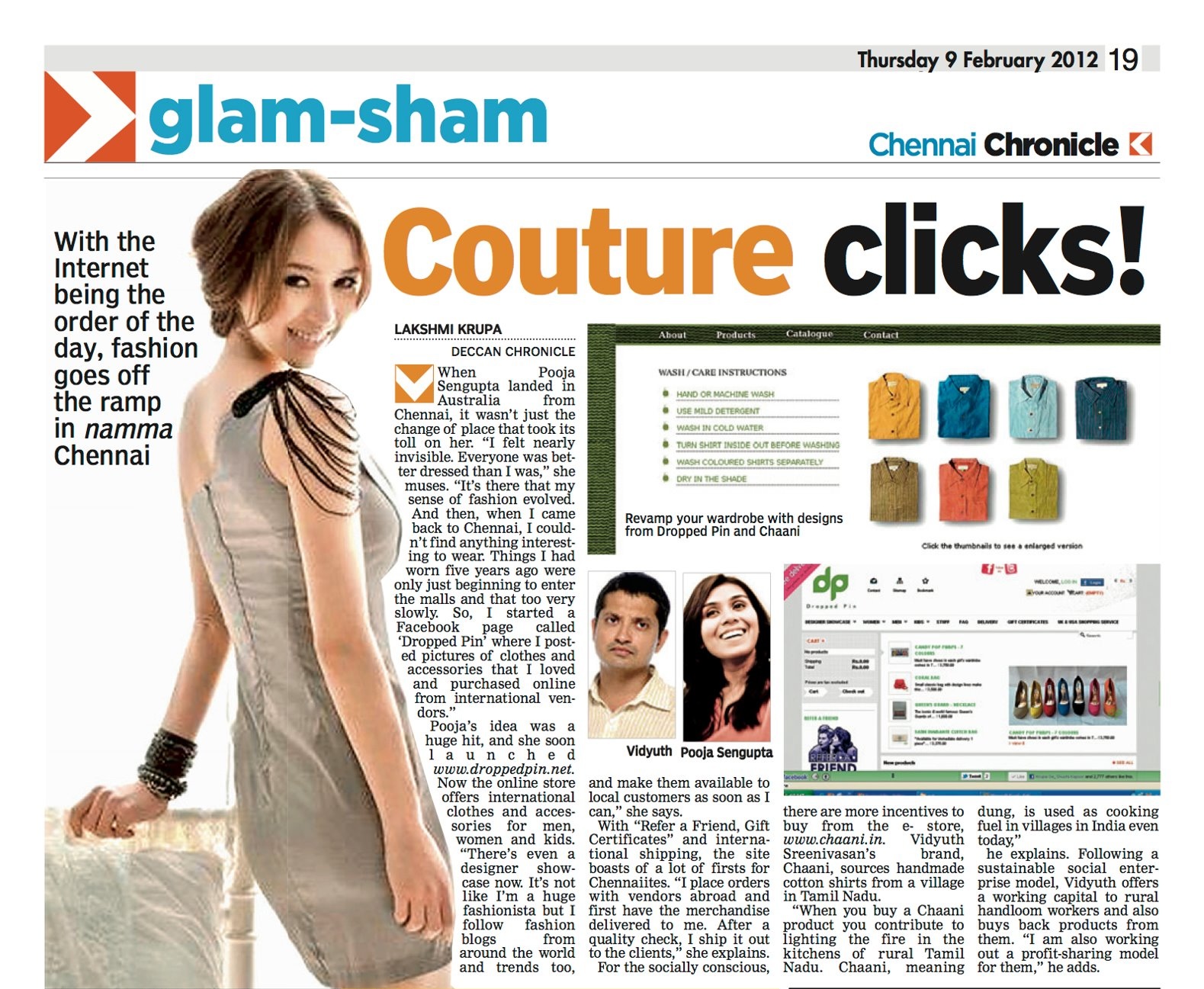
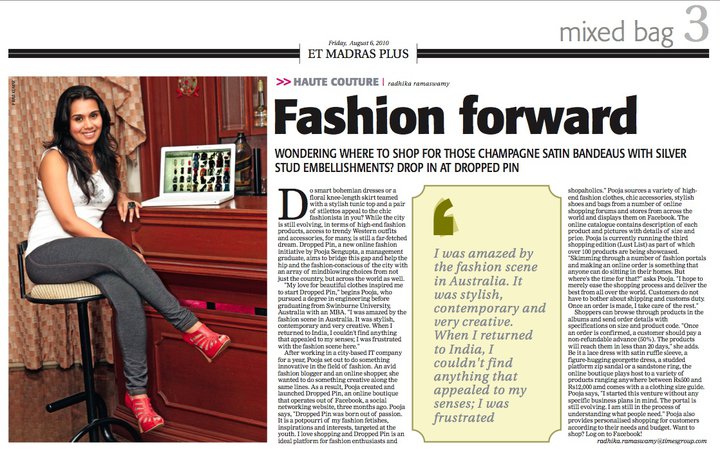
Dropped Pin started as a Facebook-based boutique in Chennai, India, around 2010. I sourced inventory directly from high-street retailers in the US, UK, and Europe—brands like Urban Outfitters, Zara, and independent labels—and made them available to Indian consumers through social commerce. The model was intentionally curated, not clearance or surplus. Every piece aligned with the editorial voice of The Lust List.
As the business grew, we expanded to droppedpin.net, a dedicated ecommerce platform. The product mix included apparel, handbags, footwear, jewelry, and accessories. Target customers were working women and young professionals aged 25–40, primarily in Indian metros. The mission was explicit: showcasing international high-street fashion to India. We wanted to be India's Forever 21, ASOS, or ZARA.
Business Model & Operations
Dropped Pin was fully bootstrapped—no external funding, no venture capitalists. I financed inventory through margin on sales and reinvested every rupee back into the business. Operationally, this meant being disciplined about sourcing, SKU curation, and cash flow. I managed everything: sourcing relationships, inventory, customer service, returns, and early product decisions.
The business gained traction in Indian media. We were featured in ET Madras Plus as "Fashion Forward," in Express Buzz as "Confessions of a Virtual Shopaholic," and other Chennai-based publications. These features weren't paid PR; they were earned through novelty and editorial appeal—we were genuinely unusual in the 2010 Indian landscape.
Lessons from Dropped Pin
Dropped Pin was my first exposure to end-to-end ecommerce operations. I learned:
- Supply-side operations: sourcing, inventory management, cost negotiation, risk of unsold stock
- Customer understanding: the blog gave me direct access to consumer sentiment before building the marketplace
- Margins and unit economics: bootstrapping meant every decision had to be cash-positive
- Niche positioning: we succeeded by being specific, not generic. We were for a particular customer with a particular taste, not everyone
- Community as moat: The Lust List readers became Dropped Pin customers and advocates
Dropped Pin eventually wound down as I shifted focus to enterprise roles that offered scale, stable income, and the opportunity to learn SaaS, marketplace infrastructure, and cross-functional team leadership. But it remained a blueprint: how to start with customer insight, move fast with limited resources, and build something that mattered to a specific audience.
Enterprise Years: Building the Playbook (2014–2023)
Between Dropped Pin and PurvX, I spent a decade in high-growth ecommerce and SaaS companies, moving through roles that deepened my understanding of marketplace operations, team leadership, and P&L responsibility.
Citibank UK (Early Career)
My professional career started in the credit cards division at Citibank UK. This was foundational for understanding financial infrastructure, regulatory constraints, and how payments systems work—knowledge that would later matter when building cross-border marketplace payments at PurvX.
GS1: Data Standards at Scale
At GS1, I worked on data standardization and catalog enrichment for 300+ brands integrating with Amazon, Google Shopping, and Alibaba. This role taught me how marketplaces ingest, normalize, and surface product information; how product data flows through ecosystems; and why data quality is non-negotiable at scale. These lessons directly inform how PurvX structures seller-provided data.
Lasoo: Catalog-to-Marketplace Transformation
At Lasoo, I led a product initiative to transform the platform from a static catalog into a dynamic marketplace. We achieved 120% month-on-month GMV growth through marketplace enablement—opening the platform to third-party sellers, automating commission flows, and optimizing the listing experience. This was my first deep dive into seller onboarding, funnel optimization, and marketplace metrics. Every lesson from Lasoo appears in PurvX's product roadmap.
Catch: Scaling a $200M P&L
At Catch, I managed a $200M product P&L on the Mirakl marketplace platform, overseeing everything from weekly promotional cycles to cross-functional coordination with production, studio, email marketing, social, and warehouse teams. I launched products, managed margins, negotiated with suppliers, and worked directly with finance and logistics. This role taught me the reality of scaling: how to align stakeholders, manage dependencies, and execute reliably under pressure.
Coles: $1.1B P&L and Team Leadership
My biggest enterprise role was at Coles, Australia's largest supermarket chain. I led cross-functional teams of 20+ people, including product managers, business analysts, merchandisers, ranging managers, and business development partners. We managed a $1.1B P&L, oversaw category strategy, and coordinated with offshore teams via Accenture. I interfaced with IT, finance, and store operations. This role taught me how to lead large, matrixed teams; how to navigate organizational complexity; how to manage budget at serious scale; and how to drive decisions across competing stakeholder interests.
What Enterprise Taught Me
By 2023, when I founded PurvX, I had deep experience in:
- P&L and financial management: from $200M to $1.1B P&L responsibility
- Team leadership: recruiting, retaining, and scaling teams of 20+
- Marketplace infrastructure: vendor relationships, commission models, data flows
- Cross-functional alignment: product, finance, operations, marketing
- Offshore operations: managing distributed teams across time zones
- Data standardization: how to scale information systems reliably
- Growth metrics: understanding unit economics, CAC, LTV, and conversion funnels
This wasn't just experience; it was a playbook. Enterprise taught me how to think, how to operate at scale, and what questions to ask. The gaps I saw in enterprise—bureaucracy, misaligned incentives, slow decision-making—became the things I was determined to do differently as a founder.
The PurvX Story (August 2023–Present)
In mid-2023, I left enterprise to found PurvX: a circular marketplace for South Asian fashion. The timing was deliberate. I'd spent a decade watching ecommerce scale, and I'd seen two major gaps:
- The secondhand fashion market was exploding in the US and Europe (Poshmark, Depop, Vestiaire Collective), but there was no niche alternative for South Asian consumers.
- Sustainability was increasingly important, but the fashion supply chain remained linear and wasteful.
PurvX is built to address both. It's a marketplace where South Asian consumers can buy and sell high-quality secondhand fashion, extending garment lifecycles, reducing landfill waste, and creating economic opportunity for individual sellers.
Cross-Border Operations
PurvX operates across two markets: San Francisco and Chennai. This was an intentional choice. The US market offered scale, network effects, and a proven product category (thanks to Poshmark, Depop, and others). South Asia offered an underserved market and authentic community. By operating across both regions, we could test product hypotheses in the US while building authentic community in South Asia.
Building from Zero
Unlike Dropped Pin, which evolved from a blog, or my enterprise roles, where I inherited existing operations, PurvX required building everything from scratch:
- Seller onboarding: How do we make it easy for individuals to list secondhand fashion? How do we verify quality? How do we educate sellers on pricing, photography, and descriptions?
- Buyer acquisition: Where do secondhand fashion buyers hang out? How do we reach them organically?
- Payment infrastructure: How do we handle cross-border payments, withholding, and seller payouts?
- Product roadmap: What features matter most to sellers and buyers? Seller dashboards? Automated moderation? Community tools?
- Growth marketing: We chose to prioritize organic acquisition, particularly SEO, rather than paid channels. This required building content, optimizing our information architecture, and investing in discovery.
Every decision was informed by what I'd learned at enterprise, but executed with startup speed and constraints.
Marketplace DNA
At its core, PurvX is a community marketplace. It's not just a transaction platform; it's a place where sellers build reputation, buyers discover curated inventory, and community members share knowledge. This DNA comes directly from The Lust List and Dropped Pin—the understanding that marketplaces built on community and curation outperform transaction-focused competitors.
Zero-to-One: Bootstrapped Growth
Like Dropped Pin, PurvX was bootstrapped from inception. No venture funding, no external capital. This constraint was intentional and liberating.
800% User Growth in Six Months
In our first six months, PurvX grew 800% in user acquisition. This wasn't driven by paid marketing or influencer campaigns. It was driven by:
- SEO and organic discovery: Content that answered questions ("How to sell secondhand designer handbags," "Sustainable fashion on a budget") ranked and drove sustainable, high-intent traffic
- Product-market fit: A niche audience that desperately wanted what we were building
- Word-of-mouth: Early sellers and buyers became evangelists, referring friends and posting on social media
- Community building: We invested in understanding our sellers' pain points and building features that solved real problems
This growth rate validated the market opportunity and proved that bootstrapped marketplaces could achieve hockey-stick metrics without venture capital.
Differentiation: Niche vs. Generalist
Poshmark and Depop are mainstream, general secondhand platforms. PurvX is niche. We're focused on South Asian fashion, sustainability, and community commerce. This niche positioning is our moat:
- We understand South Asian fashion preferences, aesthetics, and price points better than Western platforms
- We're building seller education content for a demographic underserved by English-language platforms
- We're optimizing our product for the specific friction points of our audience—payment methods, logistics, language
This is the Dropped Pin playbook: be specific, be excellent at that specificity, and don't try to be everything to everyone.
SEO as Growth Engine
Instead of paying for customer acquisition, we built SEO-driven content and information architecture. This required:
- Understanding search intent across our market
- Building content that answered questions competitors weren't answering
- Optimizing our platform structure for both users and search engines
- Investing in authentic, high-quality content rather than keyword stuffing
The payoff was compounding: each month of SEO investment improved our baseline traffic, which improved our conversion rates, which improved our margins, which funded the next month of investment.
Product & Growth Lessons
PurvX's growth wasn't just about acquisition; it was about conversion and retention. Key metrics tell the story.
3.2x Seller Conversion Through Funnel Optimization
Early on, we had strong seller interest but weak conversion. Sellers would start the onboarding process and drop off. Rather than blame the product, we dug into the funnel:
- Where were sellers getting stuck? Verification? Photography? Pricing?
- What questions did they have that we weren't answering?
- How could we reduce friction while maintaining quality standards?
By optimizing the onboarding funnel—simplifying forms, adding contextual help, providing photography guides, offering pricing suggestions—we 3.2x'd seller conversion in a few months. This came directly from Lasoo experience, where funnel optimization was our bread and butter.
Seller Dashboards and Automated Workflows
The biggest differentiator for PurvX was building seller tools that matched what we'd learned at enterprise. Our seller dashboard includes:
- Performance analytics: impressions, click-through rates, conversion rates
- Inventory management: bulk operations, status tracking, repricing
- Automated workflows: order notifications, shipping reminders, review requests
- Community features: forums, seller guides, best practices
These weren't built because they were cool; they were built because we understood, from 20+ person teams at Coles and Catch, that information and automation are what empower people to succeed. We brought that thinking to PurvX's sellers.
Community Commerce as Moat
Beyond transactions, we invested in community. This included:
- Seller education content (how to photograph, price, and describe items)
- Community forums and discussions
- Featuring outstanding sellers and collections
- Building trust through transparent policies and responsive support
The goal was to make PurvX a place where sellers felt valued, buyers felt confident, and the community felt cohesive. This is harder to scale than a transaction engine, but it's also harder to disrupt.
Enterprise Experience as Founder Advantage
There's a narrative that says enterprise experience makes you slow and risk-averse as a founder. I'd argue the opposite: if you learned the right things, enterprise is a massive advantage.
P&L Literacy
At Coles, I managed a $1.1B P&L. Every decision—from product selection to inventory levels to pricing—had P&L implications. This taught me to think in terms of unit economics, margin, and capital efficiency. As a bootstrapped founder, I apply this rigorously to PurvX. I know what metrics matter, how to read a balance sheet, and how to make trade-offs when resources are constrained.
Cross-Functional Alignment
Enterprise taught me that the best product decisions come from understanding all stakeholders: customers, employees, partners, finance, operations. As a founder, I still need to align across these groups, even if they're smaller. I've learned to communicate clearly, listen actively, and make decisions that are defensible to everyone involved.
Scaling People and Processes
I've hired and managed teams of 20+. I've built processes that work across time zones. I've translated strategy into execution and held people accountable to outcomes. These skills matter just as much in a startup as they do in enterprise—they just operate at a smaller scale and faster pace.
Risk Management
Enterprise taught me to think about downside risk: What could go wrong? What's the contingency plan? How do we build resilience? As a bootstrapped founder, this discipline is critical. We can't afford to bet the company on a single channel or customer. We need to build diversified growth, maintain healthy margins, and stay capital-efficient.
Vendor and Stakeholder Management
At Coles and Catch, I negotiated with hundreds of suppliers and vendors. I learned how to build trust, how to negotiate terms, and how to maintain relationships through ups and downs. At PurvX, this translated directly to managing payment processors, shipping partners, and marketplace infrastructure vendors.
What Enterprise Didn't Teach (But Founder Life Did)
Enterprise is stable in ways that startups aren't. At Coles, I had HR, legal, finance, and operations teams to lean on. As a founder, you're wearing all those hats. Enterprise taught me the what; founder life has taught me the how. The combination is powerful.
Frequently Asked Questions
What is Dropped Pin?
Dropped Pin was one of India's earliest fashion ecommerce startups, launched around 2010. It was born from my blog, The Lust List, where I documented international high-street fashion I wanted to own. Recognizing demand through blog comments, I sourced international brands from the US, UK, and Europe and made them available to Indian consumers. The marketplace started on Facebook and expanded to droppedpin.net, targeting working women and young professionals aged 25–40 seeking curated, international fashion.
What is a circular marketplace?
A circular marketplace is a platform that enables the buying and selling of pre-owned or secondhand goods, extending product lifecycles and reducing waste. PurvX is a circular marketplace specifically for South Asian fashion, connecting sellers of high-quality secondhand clothing, handbags, and accessories with buyers. It prioritizes sustainability and community commerce while creating economic opportunities for sellers.
How do you build a marketplace from scratch?
Building a marketplace requires solving both supply and demand simultaneously. Key components include: seller onboarding and education, buyer acquisition through organic channels like SEO, payment infrastructure, automated workflows, and community building. At PurvX, I focused on solving seller pain points first through optimized funnels (achieving 3.2x conversion), organic growth via SEO, and product roadmap alignment with user needs. Success comes from understanding your specific niche deeply and bootstrapping strategically to maintain product-market fit.
What does it mean to bootstrap a marketplace?
Bootstrapping means building and scaling a business without external funding. It requires disciplined capital allocation, organic growth strategies, and product excellence over paid marketing. Both Dropped Pin and PurvX were bootstrapped, which meant focusing on unit economics, viral or organic acquisition (SEO at PurvX), and rapid iteration based on actual user feedback rather than investor expectations.
How did your enterprise background inform your approach to founding?
Enterprise experience at Coles ($1.1B P&L), Catch ($200M P&L), Lasoo, GS1, and Citibank provided deep knowledge of cross-functional team leadership, P&L management, vendor relationships, data standards, and scaling operations. At Coles, I led 20+ person teams across product management, merchandising, and offshore operations. This taught me how to align stakeholders, manage complex workflows, and execute at scale—lessons directly applied to building PurvX's seller dashboards, automated workflows, and growth strategies. Enterprise experience de-risked the founder path.
Let's Build Something Together
If you're scaling a marketplace, building a team, or thinking through ecommerce strategy, I'd love to talk.
Get in Touch